For cutting logs and pruning trees, there is no better tool to use than a petrol chainsaw. Petrol chainsaws deliver the power needed to handle the toughest of jobs. Using a powerful 2-stroke engine, these handheld saws spin a toothed chain at high RPM to cuts through wood. Unlike electric powered models, they are not restricted by a cord or an overheating motor. Electric motors are great for handling smaller jobs but you need the power of petrol to tackle the thickest logs for any extended period of time. Maneuv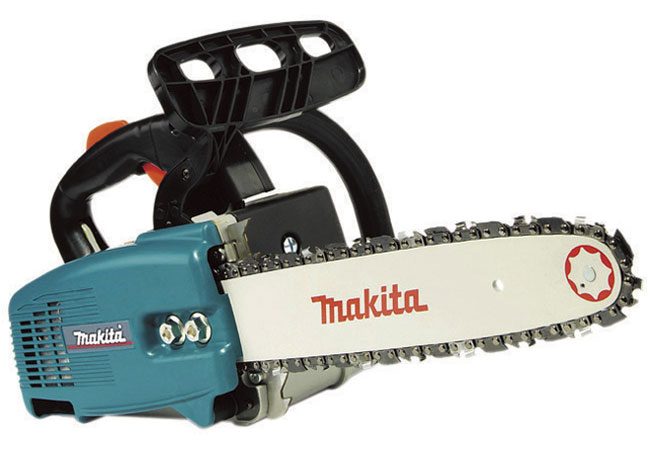 erability is key to keeping safe while using heavy tools. Petrol units are maneuverable and light enough for most individuals to carry. Two smartly placed rubberized handles allow users the utmost control.
The Guide Bar
As a prospective petrol chainsaw owner, you probably want to know about the different features available to you. Most small motors like this are considered to be a 2 stroke engine. This type of motor completes a full thermodynamic cycle in two movements of the piston. We’ll talk more about this in a later section. A chainsaw guide bar hold and guides the chain as it spins around. A high quality saw will feature a sturdy guide bar. A flimsy bar can bend if it is accidentally dropped, which is a possibility when working at higher elevations such as on a ladder. The guide bar plays a key role in the capacity of the saw. The longer the bar, the larger the logs you can cut. For example, a 16” saw can cut up to a depth of 16 inches. Because logs are circular, you can actually cut a log up to 32 inches in diameter if you follow the cut all the way around.
Cutting Chain, Oiler and Chain Adjustment
The cutting chain is actually quite sophisticated. It is similar to a bicycle chain except it has sharpened teeth at equal spacing. The chain must be oiled frequently to prevent jamming and to promote smooth operation. A new feature on the market automatically oils the chain for you. Simply pour oil into the onboard oil container and the system will distribute oil over time directly to the chain. The chain works best when it is flush with the guide bar. Over time the chain can become loose from use, and will require re-tensioning. This can be done by turning a screw or using a tool-less adjustment knob which is featured on some models.
Kickback, Vibration Reduction and Chain Brake
 Kickback is one of the safety issues every petrol chainsaw user needs to be aware of. This occurs when the blade gets caught in a groove which forces the whole unit into a jerking motion. Some chainsaws have a kickback safety function which reduces this effect. When the blade is running, the engine can produce quite a bit of vibration which can make users uncomfortable. Look for a model featuring vibration reduction to effectively reduce this problem. When you shut down the blade, you want the saw to stop spinning as soon as possible. A built in chain brake stops the blade quickly so it does not pose a danger.
Advantages Of A 2-Stroke Engine
Unlike 4-stroke engines like those in your motor vehicle, 2-stroke engines only need two movements of the piston to complete a cycle. This gives the engine a high specific power. The reduced amount of internal mechanics allows for a lightweight engine suitable for power tools. If the engine is built with an aluminum engine block, the motor will have a weight advantage over a steel block. Regular maintenance is necessary for these engines. Petrol must be mixed with motor oil to prevent seizing of the piston. The air filter will also need occasional replacement. The carburetor mixes fuel and air into the proper ratio for combustion. Trimming the carburetor may be necessary to keep the system running most efficiently.
Related posts:
